Phase 2 delivery notes
These delivery notes describe 0.1.0-alpha.3, the Phase 2 source prerelease.
The GitHub release
records its published tag and source commit. Phase 2 is complete under the
collective gate #158 review, which records the
implementation, validation evidence and limitations. The earlier alpha.2
release records Phase 1 and its prioritized performance extension. These
finite observations do not establish production SLOs.
Features
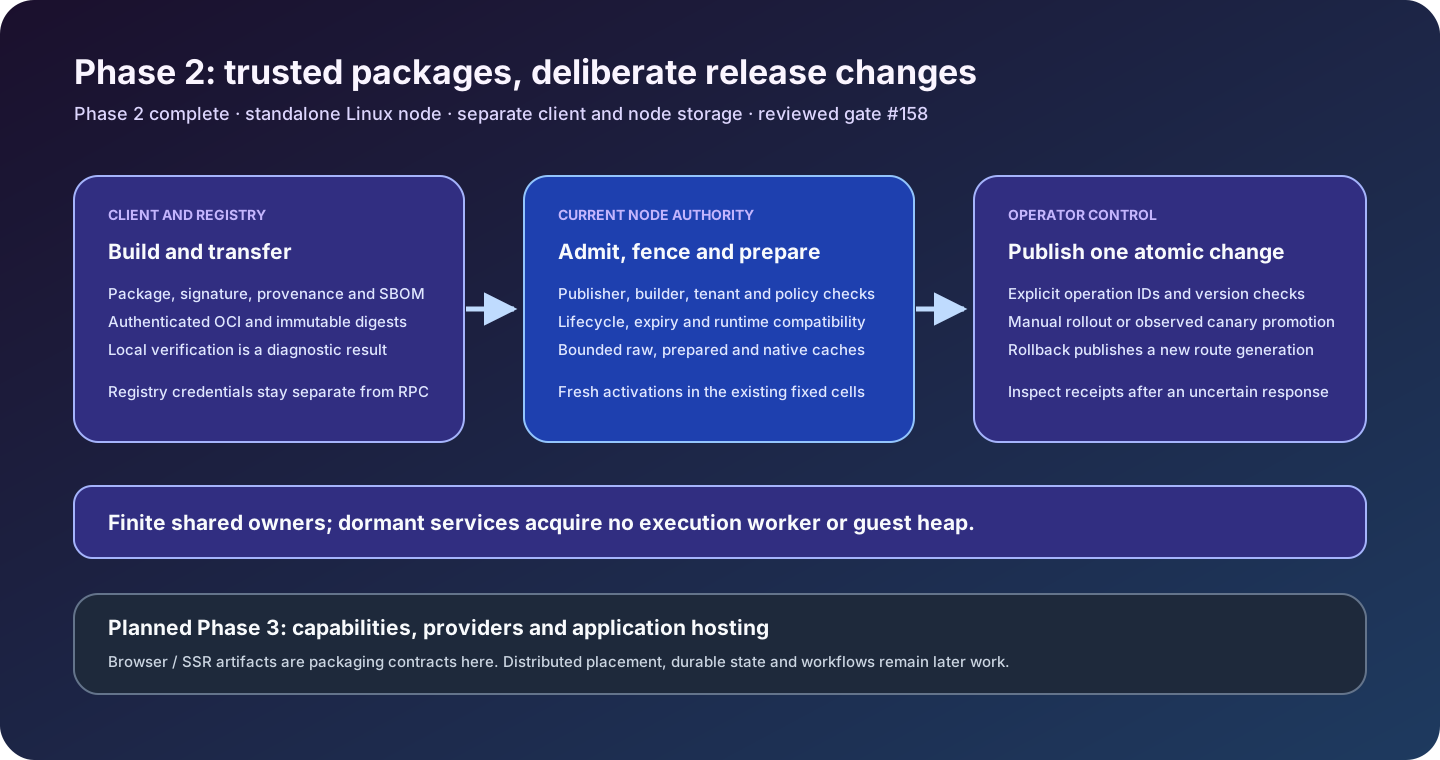
- Deterministic packaging binds original package, configuration, component, WIT and asset bytes. Explicit inventories produce SBOMs; the maintained build observer records source and tool provenance.
- Authenticated OCI transfer supports exact package and detached evidence bytes, immutable digest selection, TLS, separate registry credentials and finite transfers. It does not turn registry possession into publisher authority.
- Publisher and builder trust, tenant and SBOM policy fence catalog admission. Current authority, lifecycle and runtime compatibility are checked again before use, including cached preparation and native loading.
- Raw caching, isolated compilation and a protected persistent native cache have explicit byte, image, process and lease owners. Native output requires the approved local compiler and a separate protected authentication key.
- Durable audit, versioned managed deployments and rollout plans retain inspectable operation identities. Canary promotion uses exact observed windows; rollback restores eligible content through a new route generation and preserves existing activation pins.
- The operator CLI exposes package build/inspect/verify/push/pull, publication and lifecycle, managed deployment receipts, rollout control, observation and audit pagination. Files remain client-local; authenticated management sends bounded bytes and typed inputs.
Upgrade and recovery
Existing trusted-local catalogs retain their explicit compatibility mode. Enforced roots require complete current public policy and cannot reopen through the legacy constructor. Review admission migration and clock leases before changing policy or restarting; an immediate restart can correctly fail until its persisted future clock floor is reached. Do not delete a policy floor, catalog marker or audit journal to bypass that failure.
Deployment formats 1 through 3 retain their historical decoding rules. The first managed deployment operation writes format 4 with its bounded receipt history; rollout mutations preserve that history. Old binaries that cannot read the new format are not a supported rollback strategy. Application rollback uses current eligibility and a new publication, as described in the rollback runbook.
After a timeout, inspect the original operation ID and exact route/catalog
versions. Unknown includes absent or evicted receipts and cannot establish
that a mutation never ran. Publication identity, directory synchronization and
audit acknowledgment are separate facts. Keep original caller preconditions;
the CLI does not retry mutations or silently refresh their versions.
Registry outage prevents transfers. Already retained local bytes do not need a registry connection for invocation, but their current policy and lifecycle must still permit use. Neither cached bytes nor a cached positive proof extends expiry or reverses revocation. Corruption fails closed; recovery must use exact verified bytes and the documented catalog procedures.
Validation and limits
The bounded walkthrough uses separate client/node processes, an authenticated TLS registry and fresh public test policy. It exercises exact transfer, deployment, actual invocations, canary promotion, rollback, audit, restart and revocation. Its signed test observation is synthetic; the separately maintained observed-build integration supplies the actual build-capture evidence. Validation identifies both. The completion review additionally covers registry outage, real native trust invalidation and the fixed 32-release resource profile, with compact receipts and explicit failed or superseded attempts.
Linux reports RSS and its high-water value as approximate observations. The resource validator preserves those readings, including decreases, while CPU ticks and I/O counters must remain monotonic. A release-validation run exposed an incorrect high-water monotonicity assertion when the reported value fell from 66,506,752 to 66,502,656 bytes. The correction changes no workload, limit, process identity or ownership check, and does not rewrite the failed receipt. See the Linux field definitions and failed CI run.
This remains a standalone Linux stateless node. Package contracts for browser assets and SSR do not provide application ingress, browser hosting or rendering. The Phase 3 backlog tracks general capabilities, providers, SDK transports and web delivery. Distributed placement, durable state/effects and workflows remain later phases. Finite test profiles establish their observed behavior, not production SLOs, universal memory ceilings or a general dependency-security guarantee.