Phase 0 completion gate
Historical evidence documentation: the live Phase 0 executable and collection runners were retired from the current development tree on 2026-09-22. Commands below describe the original authorizing/reproduction environment and require the source revision recorded by the evidence; they are not current
developmentcommands.
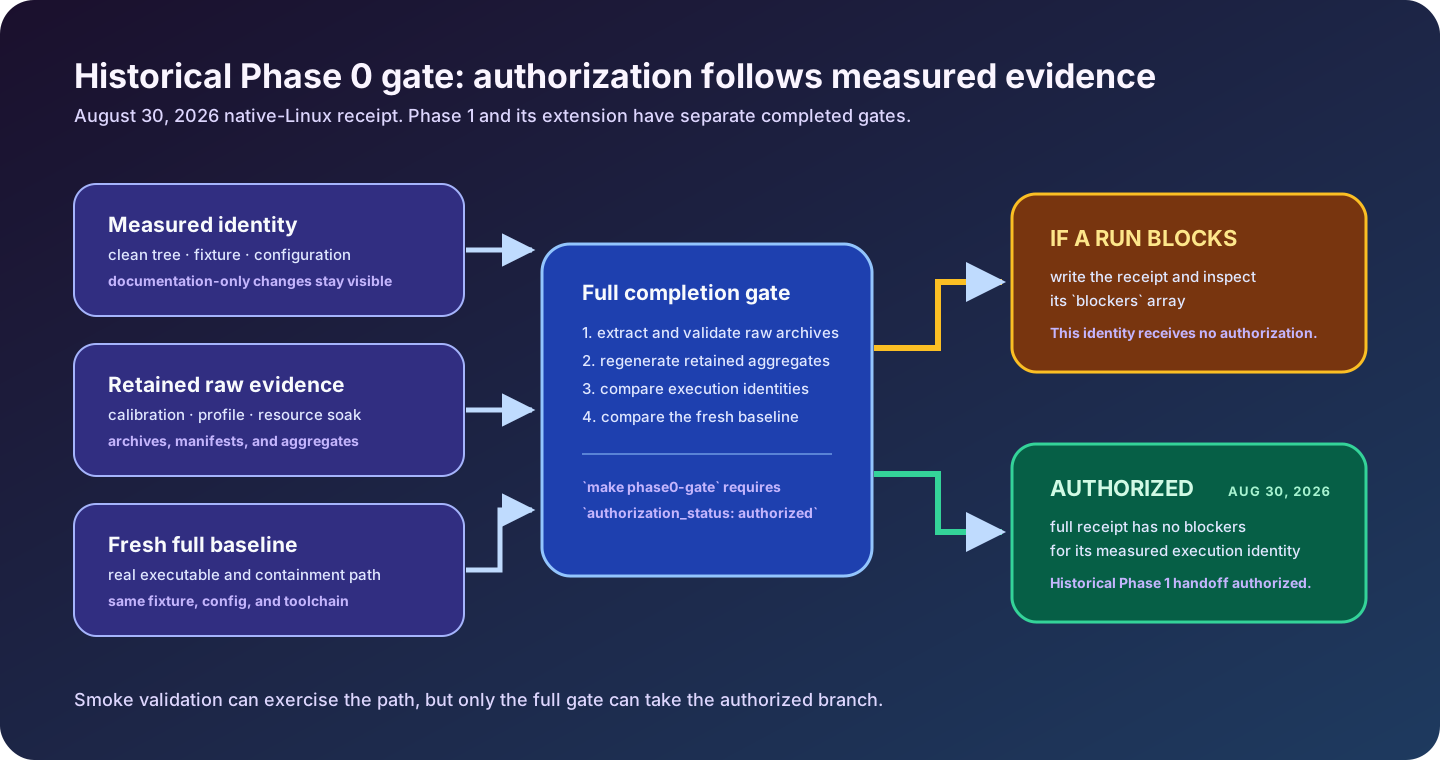
Historical gate status: AUTHORIZED — Phase 1 was authorized for the recorded August 30 execution identity.
Phase 1 subsequently completed its functional gate and optimization/comparison extension. This report preserves the original Phase 0 decision, measured identity and handoff; its authorization does not describe the current Phase 1 runtime's execution identity.
The retained August 30 gate summary
was emitted by a separate clean native-Linux checkout at commit
b932a935e0a9438a4d47383f77367146fcefaee6 (tree
5c2b93d5bc94187ae4471f5006e43c17ad218526). The full gate exited 0 and
records status: "pass", authorization_status: "authorized",
phase1_authorized: true, and an empty blockers array. It also records
production_ready: false and phase1_api_compatible: false; authorization is
a Phase 1 engineering handoff, not a product-readiness claim.
The calibration, profiling, and soak inputs were measured from the clean,
pushed commit 52ac47542a05c0a1263f78a14c04a5c2e6b761f3 (tree
cac3ececdbd0b5734691c30c0283fccff169a5f5) and retained with the gate
defaults at 7acf0736…. The gate independently reassembled and regenerated
those packages, then proved that their canonical execution-relevant identity
exactly matched the clean gate checkout:
sha256:84d0f64d5661e74ed1dd74e0f4421be8a3ee35740f85aa110775305fcd6e929b
Documentation-only commits may retain this authorization only while that
canonical identity remains unchanged; their distinct Git commit and tree stay
auditable. GitHub issue state is not evidence. The August 29 receipt and its
a724a5e3… evidence remain immutable historical records, but they are not the
source of the current authorization.
The gate remains fail-closed for every future full run: it validates retained archives, raw measurements, source identity, and a fresh baseline before it can write an authorized receipt.
Status at a glance
| Scope | Current status | What it means |
|---|---|---|
| Retained #39 calibration and resource soak | pass | The recorded native-Linux configuration has complete, verified plateau evidence. |
| Full Phase 0 completion gate | authorized | The retained August 30 clean native-Linux receipt is pass / authorized with no blockers for this canonical execution identity. |
| CI smoke sequence | validation only | A smoke pass exercises deterministic coverage; it never authorizes Phase 1. |
| Production readiness and public API compatibility | not claimed | Neither is a Phase 0 outcome. |
Some reports inside the retained evidence archives use the historical tense appropriate to their measurement runs. They are immutable evidence, not the current status source; this document and the machine receipt are authoritative for authorization.
Run the full gate
Run the full gate from a clean Linux or WSL checkout. WSL is sufficient to verify retained evidence and produce a receipt. It is not sufficient to collect replacement calibration, profiling, or soak evidence: those wrappers require a clean native-Linux host or VM and reject WSL and containers.
Before running the gate, confirm that Git sees no tracked or untracked user changes:
git status --porcelain --untracked-files=all
The gate creates its own ignored output under target/phase0-gate/. Other
untracked output can block authorization, so use an isolated clean clone or
worktree when in doubt.
After installing the pinned prerequisites in
development/toolchain.md, run:
python3.13 -m venv .venv
. .venv/bin/activate
python -m pip install --requirement tools/requirements.lock
make phase0-gate
The command creates a new directory beneath target/phase0-gate/, then:
- runs repository formatting, builds, Clippy, Rust tests, contract/component validation, SDK checks, and repository-tool tests;
- runs the real
latentd phase0-spikeexecutable E2E and containment suite; - runs a fresh full executable baseline, including the real Wasmtime path, capacity/queue saturation, recovery, cleanup, and topology probes; and
- writes
gate-summary.json, which rebuilds the calibration, profile, and soak aggregates from their retained raw inputs; verifies archive manifests, hashes, paths, and file sets; then compares the regenerated results with the checked-in aggregates before evaluating the fresh baseline.
make phase0-gate returns non-zero whenever a final receipt is not
authorized; it still writes the receipt so the specific blocker is
reviewable. The retained August 30 full run satisfied those fail-closed checks
with applicable evidence and a fresh baseline.
Interpret the result
| Command | Baseline | Exit zero means | Phase 1 authorization |
|---|---|---|---|
make phase0-gate | full | The full receipt is authorized. | Required and granted only by this result. |
make phase0-gate-smoke | deterministic smoke | The smoke validation completed. | Never granted; its receipt may remain blocked. |
The smoke output explicitly distinguishes Phase 0 smoke validation: PASS
from Phase 1 authorization: BLOCKED, so deterministic correctness coverage
cannot be mistaken for a completed full gate. When a full run blocks, inspect
the retained gate-summary.json and address its blockers; GitHub issue state
does not override them.
Current authorization evidence ledger
| Input | Machine-readable evidence | Gate result |
|---|---|---|
| Fresh full baseline | receipt baseline, compressed raw result, and checksums | pass: 20 required hard checks and all required terminal outcomes |
| Native-Linux calibration | aggregate.json and checksummed 39-part raw archive | pass: seven full-profile runs with fixed hard invariants and advisory comparison bands |
| CPU/allocation profiling | aggregate.json and checksummed 51-part raw archive | pass: eight workloads, eight candidates, full 20-check invariant proof, guardrails, and seven explicit decisions |
| Resource soak | aggregate.json, SOAK.md, and checksummed 38-part raw archive | pass: three matched 100,000-activation processes, complete lifecycle evidence, and no calibrated material growth |
| Completion receipt | gate-summary.json and receipt manifest | pass / authorized; zero blockers |
Historical August 29 ledger
The earlier baseline, calibration, profiling, soak, and
54d02679… receipt
remain unchanged for audit and archive-regression coverage. They describe the
older a724a5e3… execution identity and are not substituted for any August 30
authorization input.
| Historical input | Immutable record | Classification |
|---|---|---|
| Full baseline and receipt | native-linux-2026-08-29-54d02679 | historical pass; not a current input |
| Native-Linux calibration | native-linux-2026-08-29-a724a5e3 | historical seven-run reference |
| CPU/allocation profiling | native-linux-2026-08-29-a724a5e3 | historical v3 profile |
| Resource soak | native-linux-2026-08-29-a724a5e3 | historical three-process soak |
Recorded environment, configuration, and observations
The JSON aggregates above are cached conclusions, not trust roots. The gate validates the underlying raw runs, host observations, execution-status records, fixture/configuration/toolchain identities, profile artifacts, manifests, and hashes; it then regenerates each aggregate with the repository aggregation logic. The receipt also retains the current commit/tree and a canonical hash of the execution-relevant Git entries. Every evidence set must have that same canonical identity; documentation-only differences remain visible through the recorded commit/tree but cannot hide an execution-affecting change.
- The authorizing calibration,
perf/Heaptrack archive, and soak were measured on one native-Linux host from the same execution-relevant tree at52ac4754…/cac3ecec…. The retained commit/tree changes are auditable, while the canonical identity is the strict applicability comparison. - The calibration retains seven full-profile runs. The profile covers cold preparation, prepared-cache reuse, first/warm execution, failure containment, cleanup, and both contention modes. Its decision ledger has seven retained/deferred/rejected decisions over eight candidates.
- The soak retains three independent native-Linux processes, each with 1,000 excluded warm-ups, 100,000 measured fresh-store activations, real capacity and queue saturation batches, sampled post-warm-up resource series, and release/shutdown observations. Its strict aggregate reports matched calibration applicability, complete evidence, and passed descriptor lifecycle checks.
- The authorizing full baseline ran at
b932a935…/5c2b93d5…against those retained inputs and passed all 20 required checks. Its freshly built collector matched the retained executable digest and size exactly. The raw result is compressed losslessly and checked alongside the complete receipt manifest.
What the gate already proves
For the recorded local component and native-Linux environments, the evidence proves that:
- generated WIT guest and host bindings build a real Rust echo Component Model guest and invoke it through Wasmtime;
- echo success and declared domain errors cross the real typed boundary;
- invalid component input is rejected by the executable/containment validation path before an activation can remain leased;
- trap, timeout, explicit cancellation, and memory-pressure failures remain activation-local and are followed by successful cause-specific recovery;
- every measured terminal path returns its cell or reports quarantine, with no active lease, waiter, store, cancellation registration, activation host state, temporary buffer, or unbounded history retained;
- configured runtime workers, process count, listeners/sockets, and cell capacity remain fixed throughout the measured spike lifecycle; and
- real at-capacity and bounded-queue workloads reach their configured bounds and return admitted work to a clean baseline.
The exact checks, scenarios, executable samples, and raw observations are
validated by tools/validate_phase0_gate.py
and tools/phase0_evidence.py. The verifier
rejects malformed or synthetic archives, missing/additional/duplicate archive
paths, links, traversal attempts, changed raw artifacts, unverified profile
measurements, weakened guardrails, free-form optimization decisions, source
identity drift, and incomplete evidence presented as an authorization.
Gate completion and audit handoff
The full receipt and raw evidence are retained in the repository as immutable artifacts, including archive manifests, checksums, reports, aggregates, and the losslessly compressed baseline result. Together they establish the current authorization. Any future execution-relevant change invalidates applicability and requires fresh evidence plus a new authorized receipt; documentation-only changes must preserve the recorded canonical execution identity.
If a future full run blocks
Preserve its gate-summary.json and resolve the recorded blockers rather than
editing an aggregate, archive, or receipt. A verifier failure before a receipt
exists is not evidence that it would pass. If the blocker is execution-identity
drift, regenerate the required native-Linux evidence chain for the changed
execution path, then rerun the full gate from a clean checkout.
Audit and Phase 1 handoff
| Classification | Phase 0 asset | Phase 1 action |
|---|---|---|
| Retain | WIT authority, generated bindings, reproducible echo fixture | Keep as the maintained integration fixture and contract-generation foundation. |
| Retain | ExecutionBackend, CellPool, affine CellLease, fixed-capacity accounting | Preserve the seams and invariants while adding production implementations. |
| Retain | Machine-readable baseline, calibration, profile, and soak schemas | Keep as regression evidence; do not replace like-for-like comparison rules with SLO claims. |
| Harden | Wasmtime limits, fresh-store cleanup, interruption, bounded logging | Turn spike constants into explicit policy/configuration and telemetry without weakening cleanup proof. |
| Harden | One-entry prepared-component cache | Generalize to a bounded cache keyed by artifact, trust, and engine compatibility. |
| Generalize | Phase0ActivationRunner and phase0_composition | Add routing, admission, release resolution, budgets, and generic invocation without retaining echo-specific dispatch. |
| Rewrite | latentd phase0-spike JSON/exit-code surface | Treat it as a harness, not a public compatibility promise; replace it with Phase 1 CLI/RPC surfaces. |
| Delete after replacement | Test-only trap/infinite-loop/memory-pressure controls and benchmark-only entry points | Remove them from product dispatch when equivalent Phase 1 containment tests exist. |
Phase 1 must retain fresh invocation-owned stores, host state, import tables, instances, limiters, and activation contexts; fixed node topology; bounded state; activation-local failure containment; and affirmative cleanup proof. The profile decision record defers worker/cell policy and Wasmtime/cache/value work to #8 and #9, lifecycle-envelope work to #11, and rejects store/instance reuse plus untrusted AOT/cache/snapshot/native-execution shortcuts in Phase 0.
Explicit limits
An authorized Phase 0 gate establishes only a local feasibility and measurement boundary. It does not establish production security, stable public APIs, generic multi-service dispatch, persistent deployment management, production scheduling or telemetry, performance SLOs, dormant-service density, multi-node operation, Kubernetes replacement, realistic workloads, or arbitrary-duration leak freedom. Phase 1 issue #2's Phase 0 gate dependency is satisfied for this canonical execution identity; it must consume this evidence/handoff rather than duplicate the spike.